Virtuoso School Of Music and Art

17232 Lancaster hwy. STE 108 Charlotte NC

School office:

School Director:
Drum Lessons

Ages 4+

Book Your Trial Lesson

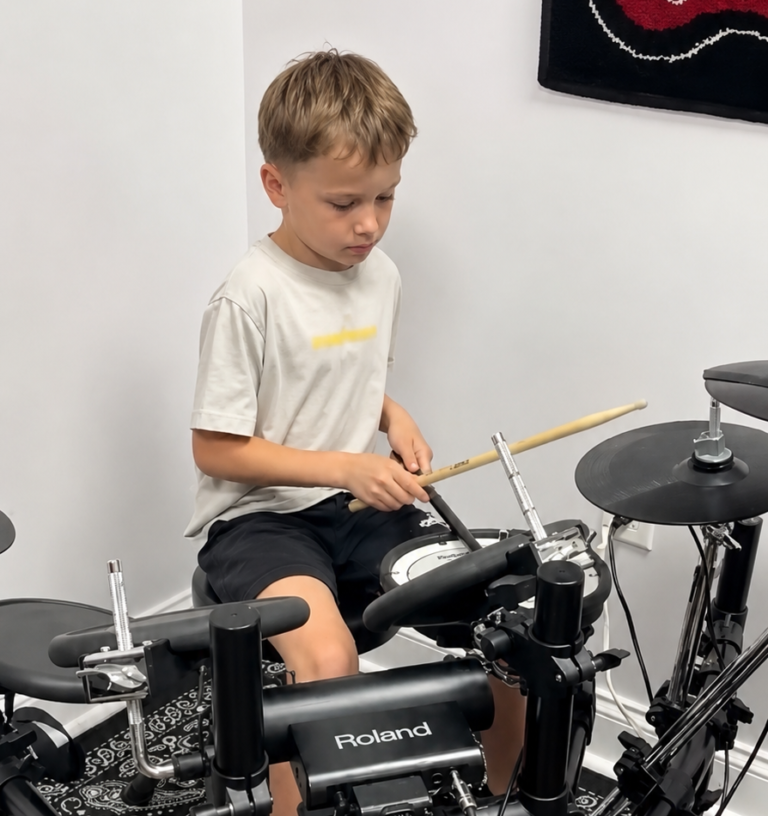
If you want to move from “keeping time” to “creating a groove,” our private drum lessons are for you. At Virtuoso School, we provide one-on-one instruction that focuses entirely on your style and goals. Whether you want to master complex jazz rhythms, heavy rock beats, or smooth Latin percussion, our private sessions are the fastest way to progress.

We use professional kits in a sound-optimized environment here in Charlotte. Your instructor will help you perfect your hand-foot coordination, speed, and musicality. We don’t just teach you how to hit the drums; we teach you how to listen and react like a professional musician. Private lessons allow for deep dives into drum theory, chart reading, and soloing. Unlock your full potential behind the kit and find your unique rhythmic voice with personalized guidance.

Beginner’s questions

How to learn drums without a drum set?

Practice on practice pads, which are quiet and affordable. Use pillow arrangements to simulate drum positioning. Practice stick control exercises on any surface. Study drum notation and watch video lessons. Use drumming apps and software. Practice foot techniques with pedal simulators or even while sitting. Many fundamental skills can be developed without a full kit, though you'll eventually need access to real drums for complete development.

How to play drums for beginners?

Start with proper stick grip (matched or traditional), learn basic rudiments (single stroke roll, double stroke roll, paradiddles), and practice keeping steady time with a metronome. Begin with simple rock beats using bass drum, snare, and hi-hat. Develop independence between limbs gradually. Set up your kit ergonomically. Our Charlotte drum instructors teach beginners the fundamentals that create a solid foundation for any drumming style.

How to learn drum notes?

Drum notation uses the standard musical staff with different positions representing different drums and cymbals. The snare is typically in the center space, bass drum below the staff, toms on various lines, and cymbals above. Learn to read rhythm notation first - quarter notes, eighth notes, sixteenth notes, and rests. Start with simple patterns and gradually increase complexity. Reading drums is essential for playing with other musicians and learning new styles.

How to learn drum beats?

Start with basic rock beat patterns (bass on 1 and 3, snare on 2 and 4, steady hi-hat). Practice with a metronome at slow tempos until smooth, then gradually increase speed. Learn beats from songs you enjoy, breaking them into components. Study different genres - each has characteristic patterns. Understand beat construction so you can create variations. Consistent practice with our Charlotte drum teachers helps you build a versatile beat vocabulary.

How to learn drum tabs?

Drum tabs simplify notation by using letters or symbols to represent drums (B=bass, S=snare, H=hi-hat, etc.) arranged on a timeline. They're easier to learn than standard notation but less precise for rhythm. Use tabs as a starting point while also learning to read standard drum notation for maximum versatility. Many online resources provide tabs for popular songs, making them accessible for self-study between lessons.

Nataly Petrova – Djambe Drums
Gift Certificate Prices Register